How Human Evaluators Shift Their Internal Standards
When an experienced quality inspector appraises an identical part twice under standard facility illumination, reproducibility is often assumed as a baseline given. Empirical evidence routinely contradicts this expectation.
During controlled re-assessment trials on precision electronic assemblies, five certified inspectors evaluated a blinded batch of 140 parts. Forty-eight hours later, without prior notice, the identical batch was presented in scrambled sequence under matched conditions. Across the team, seventeen percent of boundary calls shifted from pass to reject or vice versa. The physical items were sealed in climate-controlled storage between sessions, confirming that the discrepancy was rooted entirely in human cognitive processing rather than physical component degradation.
Human vision does not operate as an objective digital optical sensor. The visual cortex continuously synthesizes contrast, luminance, and peripheral cues to infer surface geometry. Slight fluctuations in biological circadian rhythm, pupil dilation, and previous sample exposure subtly alter defect tolerance. An inspector who has just rejected five consecutive units for severe fractures approaches the subsequent borderline specimen with heightened critical scrutiny, finding faults that slipped by unnoticed during an earlier, routine run.
A visual inspection verdict reflects the inspector's cognitive threshold at a specific second in time, not merely the physical geometry of the part under review.
— Robert Wilson, Senior Metrology Lead, Classify Twice
Key Drivers of Second-Pass Divergence
Pinpointing why a second appraisal diverges requires isolating physiological, optical, and psychological variables. Systematic tracking identifies three primary mechanisms responsible for duplicate assessment variation:
- Contextual Contrast Priming: The appraisal of any borderline specimen depends heavily on the preceding three to five samples reviewed on the line.
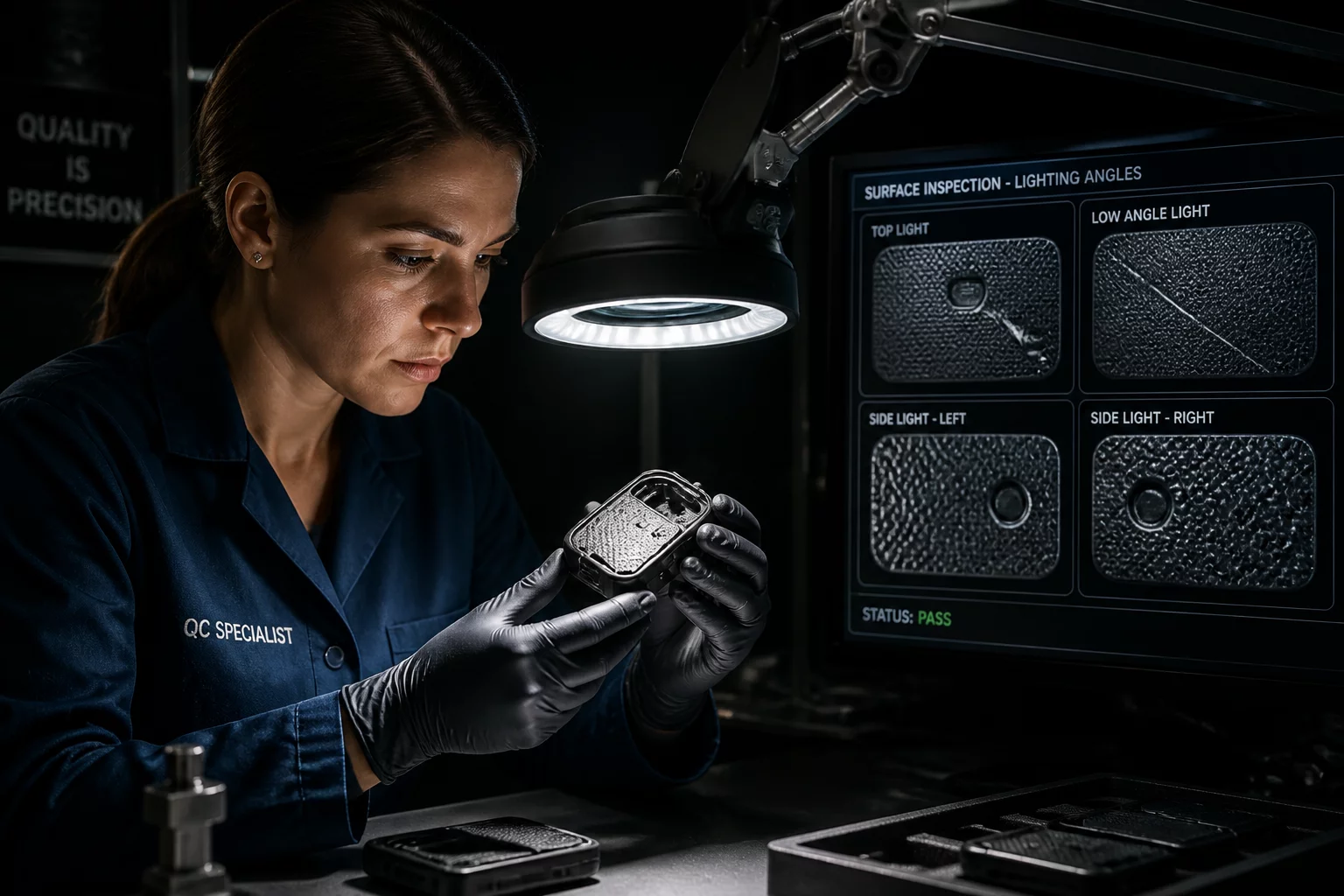
- Micro-Angle Light Refraction: A five-degree shift in hand tilt under directed task lighting transforms an imperceptible indentation into a stark shadow line.
- Cognitive Reset Between Shifts: Rest breaks and task switching clear working memory, causing inspectors to reconstruct grading thresholds from scratch.
Mitigating second-pass volatility requires structural calibration rather than individual reprimands. Facilities achieve marked consistency improvements by adopting dual-angle fixed illuminators, randomized blind verification loops, and laminated physical boundary limit samples mounted directly within the inspector's line of sight.